Along Australia’s coastline, something truly mesmerizing happens after dark. Waves roll toward the shore, and with each break, the sea seems to sparkle in shades of neon blue. It’s not a trick of the light or a photographer’s edit—it’s a natural glow produced by living organisms in the water. This glowing display, known as bioluminescence, transforms what scientists call “red tides” into a scene that feels almost otherworldly.
To the casual observer, it’s hard to imagine that the same stretch of water glowing blue at night can look reddish or brownish during the day. Yet, the shift is simple science. Tiny marine algae use chemistry to turn motion into light. Understanding how it works doesn’t make it less magical—it only deepens the appreciation of how alive and reactive the ocean truly is.
What Causes Red Tides To Turn Blue?
Red tides are not tides in the usual sense. They’re dense gatherings of microscopic algae, often Noctiluca scintillans, that multiply rapidly under the right conditions. During the day, these organisms can tint the water a reddish-brown hue. When night falls, a subtle chemical reaction within them creates light.
Inside each microscopic cell lies a special compound called luciferin. When this compound interacts with oxygen, it produces a faint blue glow. It’s the same reaction that makes fireflies shine on summer nights, just happening underwater and on a much larger scale. Each wave that rolls to shore or each splash from a swimmer sets off a thousand pinpricks of light, all reacting together.
When And Where The Blue Glow Appears?
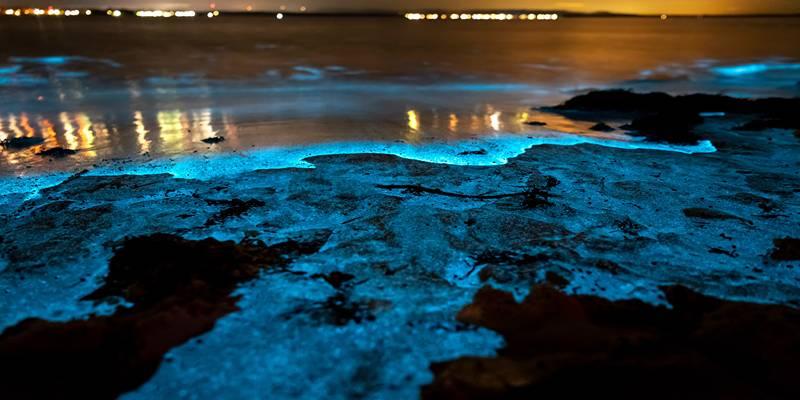
Australia’s coastline offers perfect conditions for bioluminescent activity. Warmer waters, plankton-rich currents, and calm nights combine to set the stage. The phenomenon is often spotted in places like Jervis Bay in New South Wales, Tasmania’s southern beaches, and certain parts of Queensland.
These blue glows aren’t an everyday event. They appear when algae blooms are dense enough and the water is still enough for the light to be visible. Weather plays a huge part, too. After heavy rainfall, nutrients from the land wash into the sea, feeding the microorganisms and triggering rapid growth.
A Close Look At Bioluminescent Reactions
Bioluminescence might sound like something out of science fiction, but it’s pure biology. When disturbed, the algae release a flash of light lasting only a second or two. Scientists think this serves as a defence mechanism, startling predators or drawing in larger creatures that might eat those predators.
On a molecular level, the light happens when luciferin mixes with an enzyme called luciferase. Add a little oxygen, and you get an instant burst of blue. It’s a chemical conversation between life and energy. Unlike electrical light, it doesn’t generate heat, which is why it’s sometimes called “cold light.” The reaction is incredibly efficient—nearly all of the energy becomes light instead of heat.
The Dual Nature Of Red Tides
While bioluminescent nights draw tourists and photographers, red tides themselves aren’t always harmless. Certain algae species can release toxins that affect fish and marine ecosystems. The Noctiluca species responsible for most of Australia’s glowing tides, however, is largely non-toxic. It’s more of a nuisance than a threat.
Still, large blooms can deplete oxygen levels in the water, stressing marine life. That’s why scientists watch them closely. But on calm nights, when the glow appears, it’s usually safe to admire. For locals, it’s a chance to experience a living, glowing ocean without danger—an extraordinary reminder of nature’s delicate balance between beauty and biology.
How Scientists Study The Glow?
Researchers use sensors, drones, and satellite images to track where and when bioluminescent blooms appear. They measure water temperature, salinity, and nutrient levels to predict when a new bloom might form. Since these organisms are sensitive to environmental change, they can act as early indicators of shifts in ocean health.
By studying the glow, scientists aren’t just chasing pretty pictures—they’re collecting valuable clues about marine ecosystems. Patterns in the light can reveal how warming waters, pollution, and nutrient runoff affect sea life. Some researchers are even exploring ways to use bioluminescence in medicine and environmental monitoring.
The Human Connection To The Glow
For many Australians, witnessing a glowing tide is an unforgettable moment. Families head to the beach at night, whispering in awe as the waves light up around their feet. It’s the kind of natural event that reminds people how alive the ocean really is.
Even scientists who study the phenomenon for years still feel that sense of wonder. They might explain the chemistry behind it, but when the beach glows bright enough to paint footprints in blue, it feels closer to art than science. It connects people to something bigger—an ocean that glows not for show, but simply because it can.
What The Blue Light Tells Us About Nature?
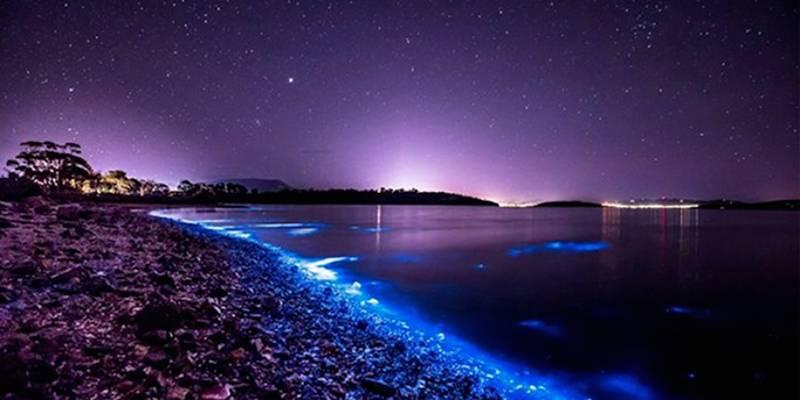
The glow of a red tide isn’t random. It reflects how life adapts in remarkable ways. These organisms don’t use light the way humans do, but their glow plays a part in survival. It warns predators, creates a distraction, and helps them thrive in dark seas.
At the same time, it offers a small window into how interconnected natural systems are. A little change in temperature or pollution level can shift the balance. So, the glowing tides act like nature’s messenger, hinting at what’s happening beneath the surface.
When the water lights up, it’s easy to forget the science and stare. But each sparkle tells a story—of chemistry, adaptation, and the fine line between beauty and imbalance.
Conclusion
Red tides in Australia might sound like something ominous, yet at night, they become one of the most enchanting sights the sea can offer. Their transformation from murky red to electric blue shows how life can turn even microscopic reactions into breathtaking displays.
The next time the waves glow under a dark sky, it’s worth remembering what’s really happening—a sea alive with invisible artists, each flash of blue created by living cells reacting to motion and light. It’s not magic, though it feels like it. It’s the ocean reminding us that even the smallest forms of life can create something spectacular enough to make people stop, stare, and smile.