Most visitors to Paris spend their time looking backward. They focus on the 19th-century boulevards, the medieval islands, and the classical palaces. Taking the RER A train to La Défense feels like fast-forwarding fifty years and landing in a different city entirely. This is not the romantic Paris of Amélie. This is the economic engine of France. The district is a dedicated business zone that sits on a massive concrete slab raised above the highways. It is noisy, windy, and impressive in a brutal, crushing sort of way. Visiting here requires a shift in mindset. You are not here for quaint cafes. You are here for scale.
The Roof Closure And The Staircase Reality
The most critical piece of information for any traveler planning this trip today is simple: the roof is closed. In April 2023, the administration permanently shut down public access to the panoramic terrace for economic and technical reasons. You will still see old guidebooks and outdated travel blogs promising a view from the top. They are wrong. Do not buy tickets from third-party resellers who haven't updated their inventory. You will only end up arguing with a security guard at the base.
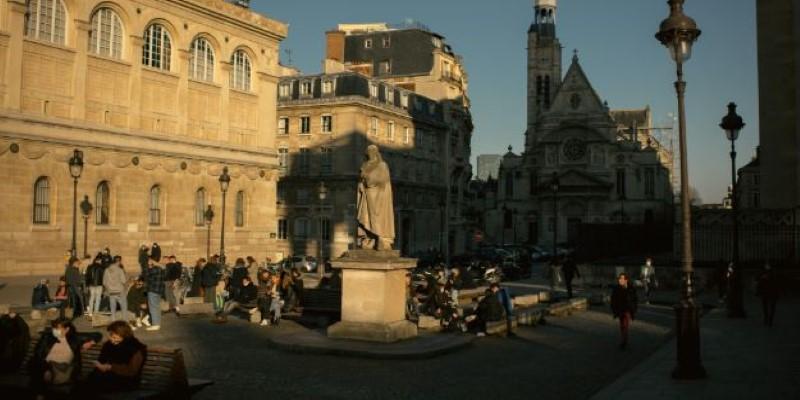
The attraction now is the structure itself and the famous "steps" leading up to it. These wide, white marble stairs serve as the district's communal seating area. On a sunny weekday, thousands of office workers spill out of the surrounding towers to eat sandwiches here. Joining them offers a legitimate slice of Parisian life that you won't see in the Latin Quarter. It is a social scene.
Sitting on these steps gives you a direct line of sight down the "Axe Historique." This is the historical axis of Paris. From your position on the stairs, you look through the empty center of the Arche, across the esplanade, past the Arc de Triomphe five kilometers away, all the way to the obelisk at Concorde and the Louvre. It is a rare moment of perfect urban alignment. You don't need to be high up to appreciate it; the ground-level view is actually more powerful because you see the layers of the city stacked on top of each other.
Navigating The Wind Tunnel And The Esplanade
The geography of La Défense creates a specific weather phenomenon that catches tourists off guard. The tall buildings funnel the wind across the pedestrian slab. It is almost always windy here. In winter, the temperature feels five degrees colder than in the city center. In summer, the white stone reflects the sun, creating a baking oven effect with zero shade.
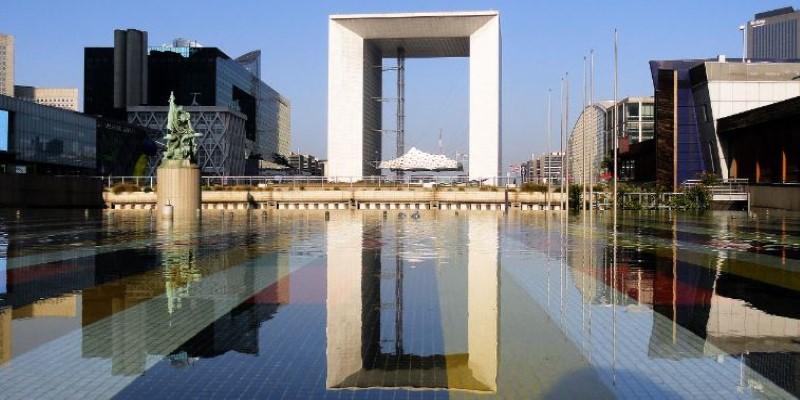
Walking from the Metro station to the Arche involves crossing the Parvis de la Défense. This is a massive pedestrian zone. It functions as an open-air museum, though few people stop to realize it. As you walk toward the Arche, you pass massive sculptures that are often ignored by the rushing commuters. There is a giant red stabile by Alexander Calder and bright figures by Joan Miró.
The scale of the walking distances here is deceptive. The Arche looks close when you exit the station, but it is a solid ten to fifteen-minute walk. The buildings are so large that they mess with your depth perception. We often see families with small children struggling halfway across the slab because they underestimated the trek. Wear walking shoes. The ground is paved with large stone tiles that can be uneven.
The Business District Rhythm And Weekend Dead Zones
La Défense operates on a strict clock. It is built for the Monday-to-Friday workforce. If you visit on a weekday between 12:00 PM and 2:00 PM, the energy is frantic. Food trucks line the esplanade. The restaurants in the Westfield Les 4 Temps shopping mall are packed to capacity. The noise level is high. This is the best time to visit if you want to feel the pulse of modern Paris.
If you need food, your safest bet is the Westfield mall located just to the left of the Arche. It is one of the largest malls in Europe. It is not culturally significant, but it is a logistical lifesaver. It has clean toilets, air conditioning, and a massive food court that stays open on weekends. If it starts to rain, and there is very little cover on the outdoor esplanade, the mall is your only real shelter.
Avoid trying to find a "cute bistro" in the immediate vicinity of the Arche. The restaurants here are designed for corporate expense accounts or fast casual dining. They are efficient and often overpriced. If you want a memorable meal, take the Metro back to Pont de Neuilly or into the city after you finish your walk.
Photography Logistics And The Best Angles
Photographing the Grande Arche is technically difficult because of its size and the high contrast of the white marble. On a bright day, the glare blows out the highlights in your images. The best light is usually late afternoon when the sun hits the western face of the building or during the "blue hour" just after sunset when the office towers light up.
The classic shot is from the bottom of the stairs looking straight up. It emphasizes the brutalist geometry of the cube. However, a more interesting angle is from the far end of the esplanade, near the Takis Basin (the pond with the weird lights on sticks).
From here, a zoom lens lets you compress the distance and make the Arche look as if it’s hanging right over the people below. Another spot worth trying is the “Japan Bridge,” a pedestrian crossing over the ring road. It gives you a clean view of traffic sliding beneath the glass towers and nails the cyberpunk feel of La Défense. Just watch your tripod placement. Security guards for individual buildings can be quick to step in, and the line between public space and private plaza is often just a shift in paving stones. If waved off, move a few meters back.
Conclusion
La Grande Arche stands as a burst of modern ambition against the rest of Paris. You can’t climb it anymore, but it still anchors the city’s long historic axis. The draw isn’t a viewpoint, it’s the heft of the structure and the strange, open feel of the business district around it. The wind cuts through the plaza, the scale feels bare and bold. Stop for the architecture, eat a quick sandwich on the steps with the office workers, then hop back on the RER and slip into the older Paris that feels a world away.